Monday, March 25, 2013

Service Logic (Delta Force Paintball)

Service logic as explained by Grönroos (2010). He says, “The essence of the service logic for the customer and the provider, respectively, is: 
  1. When using resources provided by a firm together with other resources and applying skills held by them, customers create value for themselves in their everyday practices (customer service logic). 
  2. When creating interactive contacts with customers during their use of goods and services, the firm develops opportunities to co-create value with them and for them (provider service logic).” (2010, p. 299) 
Gronroos (2008, pp. 223-224) argues service logic involves five major factors.
  1. Understanding the value that emerges for customers by consuming or using offerings of an organisation and knowing how services alone or together with information, physical goods or other kinds of tangibles contribute to this value.
  2. Understand how total quality is perceived in customer relationships to facilitate such value and how it changes over time
  3. Understanding how an organization (people, technology and physical resources, systems and customers) will be able to produce and deliver this perceived quality and support customers' value creation.
  4. Understanding how an organization should b developed and managed so that the intended quality and value are achieved
  5. Making an organization function so that this perceived quality and value are achieved and the objectives of the parties involved (the organization, the customers, other parties, etc.) are met. 
This means the firm has to understand the following:
  1. The perceived quality and value in their everyday activities and processes customers are looking for. 
  2. how to create that value support for the customer
  3. how to manage the resources available to the organization to achieve such service-based value creation. 
The example of Delta Force Paintball shows how this service logic involves understanding the broader social, cultural and technological trends for people seeking novel experiences. 

Delta Force Paintball

Paintball is a sport or a war game in which players compete, in teams or individually, to eliminate opponents by tagging them with paintballs. 
I

Illustration 1: The cast of 'The Big Bang Theory' play paintball 

Equipment is very important in paintball. The paintballs themselves are capsules containing water-soluble dye with gelatine outside shell which is propelled from a paintball gun. 

Protective clothing is also important, including a compulsory face-guard. Players are required to wear masks when in the field of play, and there are strict protocols around safe practice to ensure no one is really harmed. 

Games can be played on outdoor or indoor fields. There are many examples on the Internet of maps of fields of play, one of which is reproduced below of Paintball facility in Australia. A game field can be created with natural or artificial terrain. In New Zealand, one initial terrain included an abandoned freezing works facility. Players use cover to launch sallies against the enemy or to defend their position. 

Terrain Map Skirmish HQ Gold Coast Paintballing Facility in Australia 

You can even get applications now for phones and other hand-held devices to orient players and help them strategize during gameplay.

Screenshot of Interactive Map Marker for use during Paintball play  

Many different games and scenarios can be run by organizers. Generally, games involve: Speedball, played on a small flat area with artificial barricades; Woodball, played in the woods; and Milsim, which is short for military realism – scenarios are based on real-world combat situations. Scenarios include capture the flag, invade an area, or find a thing, zombie apocalypse, elimination rounds, and so on. Games can last from seconds or be played over several days. There are also 'freedom' paintballers, who 'go bush' and play amongst themselves in free play. Luckily paintballs are biodegradable. 

In the USA and Britain, the game is played regularly as a competitive organized sport. There are even professional teams. Paintball facilities and technologies are also used in training for military forces, law enforcement, paramilitary services and security organizations, riot response, and for training people in the "non-lethal suppression of dangerous suspects”. 

Delta Force Paintball was established in the United Kingdom in 1989. Delta Force made a big impact because they made the sport more professional, and oriented paintball to families and social activity more generally, rather than focusing on competitive fighting. Success factors for Delta Force's have been their focus on professional customer service, safety, and family-oriented fun and enjoyment. 

Since their entry into paintball, player numbers have significantly grown, as has player satisfaction, according to their website. After starting in England they expanded into Wales and Scotland, and are now located in 7 countries on 3 continents. Their Woodhill facility is the first Delta Force paintball facility in NZ, and they intend to expand and develop facilities in and around all major cities in NZ. 

The inspiration for Delta Force terrain is film and terrain is clearly designed with specific scenarios in mind. Delta Force Paintball at Woodhill in Auckland featured an Egyptian themed area (‘Raiders of the Lost Arc’), and also found inspiration in the films 'Tomb Raider', 'Tropic Thunder', 'Resident Evil' and 'Fuel Dump'. 

'State-of-the-art' equipment revolutionised the sport. Although basic equipment (guns, face helmets and overalls) are made available, upgrades available and people can bring their own equipment. Although rapid action guns (machine guns) are not allowed in NZ, guns can be upgraded, and own equipment may be worn by committed and regular players. 

Delta Force Paintball focus on the social nature of the game, suggesting a paintball session could be used as an event like Buck or Hen parties, Birthdays, Corporate functions, or just groups of friends or family to have a good fun day out. On their Facebook page you can see a large number of family groups, groups of children, and many women, indicating the spreading popularity of the sport into sectors it did not previously attract. 

Delta Force Paintball says it wants to have paintball centres in every major city in New Zealand, and with the continued growth of the activity, this seems reasonably likely. They say "It is our corporate goal to promise you the very best paintballing experience imaginable – in terms of quality, safety, value and enjoyment". They now have 20 years experience in the business, and employ more than 1000 people worldwide. 

Managing quality is an issue for an organisation like Delta Force Paintball like it is for any service organisation. Professional Standards can be recognised by belonging to professional associations, like the UKPA (United Kingdom Paintball Association). Paintball can also have their facilities rated by independent authorities.

A day out paintballing is not cheap, especially for a family. Other than price, another barrier to involvement is the travel - a car-hike into the outskirts of North Auckland. Despite the cost and the effort to get there many dedicated paintballers engage in Paintballing regularly at Woodhill and other facilities. In terms of overcoming the cost barrier, Delta Force have several tactics. They promote through booths and stalls at University Orientation Days and in Shopping Malls, offering low cost or free entry to the facility, with the first 100 paintballs free. Facebook deals are available, they have a price match promise, and other special deals to encourage first-taster use and return custom. Once at the facility paintballs must be bought and this is where Delta Force makes much of its money. Costs are available on their site. 100 paintballs do not last long, especially if you are new to the game and excitable. Some new players can use 100 balls in 10 minutes of play.

An interesting aspect of Delta Force Paintball is the way it co-creates value with the customer through levering excitement about the game through interactive gaming culture, social media, and film. The experience of playing Paintball directly draws on gaming experiences such as Halo, classic ‘shoot-em-up’ games, and films like Tropic Thunder and Zombie Apocalypse. 


References 


Grönroos, C. (2010). Service management and marketing: Customer management in service competition. Chichester: John Wiley and Sons Ltd. 

Wikipedia reference for 'Paintball' at http://en.wikipedia.org/wiki/Paintball


Delta Force Paintball Woodhill on Facebook http://www.facebook.com/deltaforcewoodhillforest


Monday, March 18, 2013

Service Guarantee

A service guarantee is a promise and so it drives the process and outcome. A guarantee helps everyone understand what the organisation delivers in terms of an experience process and outcome, and it also drives continuous operational improvement and the service recovery programme.

Activity: Answer the following questions:
  1. What is a service guarantee?
  2. Name some excellent service guarantees you are aware of. How do they work to create confidence in the service and increase perception of quality of the service?
  3. Consider ‘The Warehouse’ guarantee below. If you make a purchase at the Warehouse how does the guarantee make you behave and feel? What would the challenges be for a manager at the Warehouse to manage their guarantee?
  4. What are the four acid tests of a service guarantee? (see below)
  5. What are the downsides of guarantees? Design a guarantee for a service of your choice based on the principles outlined in the text (including that it is meaningful; easy to understand; explicit; unconditional; and the payout).

What are the benefits of having a guarantee like this and what could go wrong?
Two examples of guarantees are given below.


Countdown Online Grocery Shopping Guarantees:

The Warehouse returns policy is available here.   Below are their procedures for people who would like to return a product:


Further Reading


Hart, Christopher (1988). ‘The power of unconditional service guarantees’, Harvard Business Review, July-
August, pp. 54-62.

Firnstahl, Timothy (1989). ‘My employees are my service guarantee’, Harvard Business Review, July-August, pp. 4-8.

Fitzsimmons, J., & Fitzsimmons, M. (2006). Service management: Operations, strategy, information technology. (5th ed.). Sydney: McGraw-Hill/Irwin.

Kashyap, Rajiv (2001). ‘The effects of service guarantees on external and internal markets’, Academy of
Marketing Science Review, No. 10.

Service Package

Sometimes service managers refer to service packages. The service package is a way of understanding what a service offering is made up of. A service package can be made up of both tangible elements and intangible elements. Sometimes these are divided into five elements:
  1. Supporting Facility:  The physical resources that must be in place before a service can be sold.  Examples are a golf course, ski lift, hospital, airplane.
  2. Facilitating Goods:  The material purchased or consumed by the buyer or items provided by the consumer.  Examples are food items, auto parts, legal documents, golf clubs.
  3. Explicit Services:  Benefits readily observable by the senses.  The essential or intrinsic features.  Examples are quality of meal, attitude of the waiter, on-time departure.
  4. Implicit Services:  Psychological benefits or extrinsic features which the consumer may sense only vaguely. Examples are the privacy of loan office, the security of a well-lighted parking lot.
  5. Information. 
The service package concept can help managers focus on managing quality. Managers can go through each of the elements of the package concept and decide how to ensure quality service provision across all the elements involved. Then a simple checklist can be created so that quality can be managed.

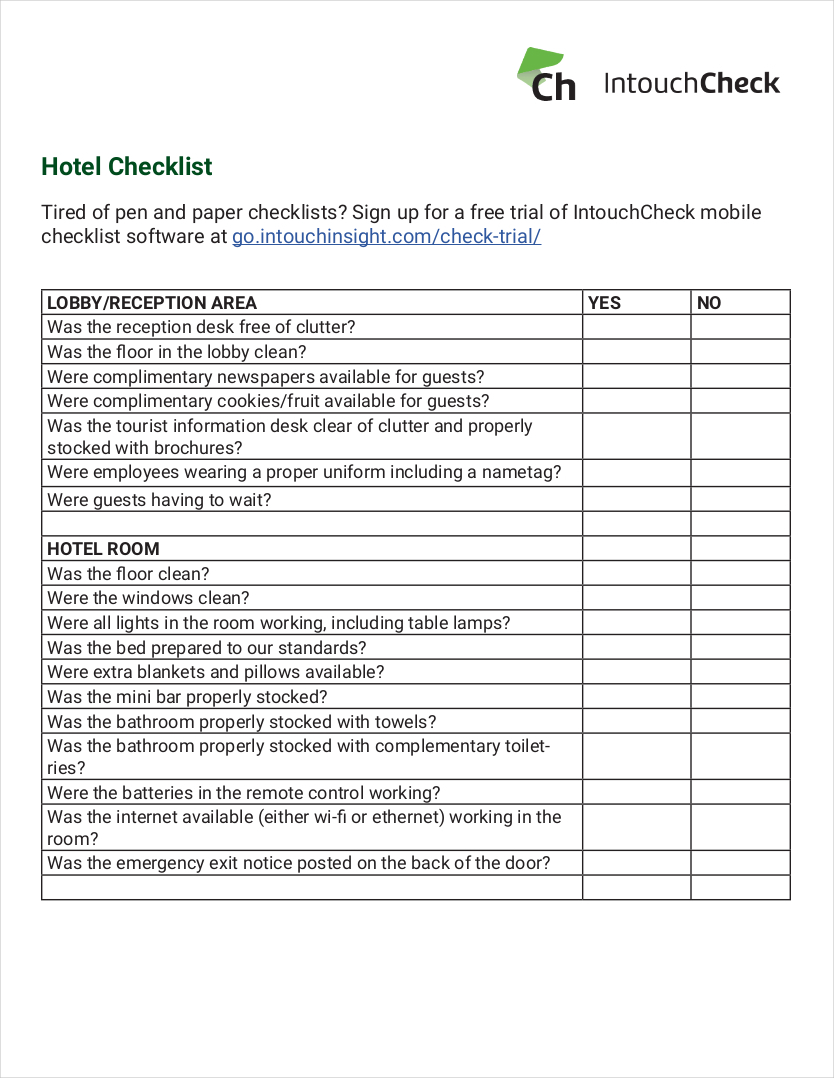
An example of a checklist for a hotel is below. You can see a mixture of the five elements above made describable in the checklist so they can be assured.


Image result for simple quality checklist hotel room


Service Productivity Model - Grönroos

Service productivity

The basic productivity challenge for service businesses is explained by Professor Grönroos in the video below.


Essentially Grönroos is saying that if services implement manufacturing models to service process delivery performance is negatively impacted (see Grönroos Figures 9.1 to 9.3).

Cost-cutting approaches are normal in manufacturing processes but if taken in service businesses then eventually profit will go down. Why? In manufacturing or product logic cost-cutting shouldn't decrease profitability (say if linked to the uptake of technology or getting rid of excess bureaucracy). But, if using service logic, if processes are constantly cut then perceptions of quality will eventually go down. People will notice that there is less help available, there are longer waiting times, etc. and so revenue will go down. Costs do go down of course but profitability also goes down. The consequence for a service business is that they should know where their breaking point is. But this breaking point is difficult to discern so managers have to be very careful to watch out for when profits start to go down as this is a strong signal service logic is not operating.

As an alternative to using a product logic, Grönroos argues for service logic in increasing productivity. This is explained in more detail in Figure 9.4 below. One needs to understand the actual process of creating value in order to understand where costs can and can't be cut, and where investment should be made to increase productivity. So for example, understanding what is a back-office process that can be automated. Or understanding what front of office self-help activities might be able to be pushed toward the customer that they could get value from (e.g. online banking and the ability to manipulate money between accounts).
Grönroos Figure 9.4

For service businesses, the focus is always on the relationship with the customer. If cost-cutting impacts negatively on this relationship then the service logic which should underpin the relationship is at risk. Of course, cost-cutting is sometimes desirable and advisable, but Grönroos argues that the relationship should underpin all decision-making and this is shown in Figure 9.6 below. Productivity is improved in this model by investing in the relationship's continuity by gaining mutual value out of the relationship. He links this to learning as these relationships are always dynamic and growing.


Grönroos Figure 9.6

Reference

Grönroos, C. (2010). Service management and marketing: Customer management in service competition. Chichester: John Wiley and Sons Ltd. 


Saturday, October 13, 2012

Service recovery

Last updated 19 September 2019

This post covers why all service businesses should have a service recovery process and also covers some aspects of how to achieve continuous improvement through the recovery process. I also look at the role of the apology, how to deal with difficult customers, the importance of allowing mistakes (as well as learning from them and fixing them) in service innovation, and finally, I critically analyze an incident on a Jetstar flight and discuss some complexities in service recovery.

In the introduction, there are several key aspects of the service recovery process.
  1. Failure will occur in complex service process delivery. Every failure is a promise not kept. If a promise is not kept then there is a perceived 'moral lack' in the organisation. Another way to look at service recovery is as a way to repair a relationship that has gone wrong.
  2. Service recovery is part of a continuous improvement process.
  3. Seek complaints in order to collect information about processes in order to improve them.
  4. Seek complaints as learning opportunities.
  5. Paradoxically an organisation needs to aim for fault-free processes, but they should also have a culture where mistakes are allowed. Without mistakes, learning cannot occur.    
  6. Well-solved complaints will delight the customer and cement their loyalty.
The impact of dissatisfaction

If dissatisfaction occurs in service delivery two main things can happen: either the customer takes action about their dissatisfaction, or they don't. 

Johnston and Clark (2008). Service management. Improving service delivery.  Pearson: London. 

It might seem that the second option, 'no action' is the best option for the firm, but this is not the case. If someone takes 'no action' they are likely to not go back and then you never have the opportunity to understand what when wrong from their point of view. In the action options, both actions of public and private action are not necessarily damaging. Actually, seeking direct redress from the firm is probably the best possible outcome, because at this point the business has the opportunity to recover from the service failure, with the accompanying possibilities of creating a more loyal customer through solving the customer's problem. Also, implementing service recovery in a timely way can help mitigate the effects of legal action and complaints to other agencies like private and governmental agencies and watchdogs.  The options of private action - stop buying the product and warning friends about the product or seller - are the two actions that a service business should curtail by making sure that they encourage complaints so that people feel confident and secure in telling a service where they went wrong.

The cost of dissatisfaction is graphically shown in the next figure:

Johnston and Clark (2008). Service management. Improving service delivery.  Pearson: London. 

You can see from this figure that the number of people told increases exponentially according to how dissatisfied a customer feels. One doesn't need too much imagination to realize that with social media like facebook and twitter the number of people that can be told about a poor experience can potentially reach the thousands and even millions. The mass media can also exacerbate a problem if it is not fixed immediately. Further on in this post, I discuss an example using Jetstar who took their time implementing service recovery after a drunk passenger urinated in the aisle of a plane. This story was taken up in the media and because of a huge story over several days.

The next figure shows what types of action people take based on levels of dissatisfaction.  Actions include telling friends, complaining, making a fuss, not use again, and dissuade others.

Johnston and Clark (2008). Service management. Improving service delivery.  Pearson: London. 

One striking issue from the graph above is the impact of word-of-mouth on return custom. "The average business only hears from 4% of their customers who are dissatisfied with their products or services. Of the 96% who do not bother to complain, 25% of them have serious issues. The 4% complainers are more likely to stay with the supplier than 96% non-complainers. About 60% of the complainers would stay as customers if their problem was resolved and 95% would stay if the problem was resolved quickly. A dissatisfied customer will tell between 10 and 20 other people about their problem. A customer who has had a problem resolved by a company will tell about 5 people about their situation" (Johnston and Clark, 2008).

Approaches to service recovery

The above statistics reinforce the need to have a robust service recovery process in place. Not only does a well-carried out service recovery process cement customer loyalty, but it also turns the word-of-mouth 'bad news' stories into 'good news' stories. A further point to remember is that service recovery is not a one-off process undertaken to fix mistakes. Serve recovery should be seen as part of a systematic continuous improvement process. Businesses should seek complaints so that they can see more clearly exactly what it is customers want and provide it. They can identify where systems are not working, and fix it. In addition, and is not often mentioned, service providers can identify whether or not they can actually meet needs. If there is a gap between expectation and perceptions that is leading to dissatisfaction and complaints then how can the gap be closed? Yes, the service provider can fix an error, but they can also identify if they need to train the customer more effectively to use a service, but also by other means like selecting customers more effectively.

Four basic service recovery approaches are used by service organizations. First, there is the case-by-case approach. In this approach, each customer’s complaint is dealt with individually. The downside to this approach is that other customers may perceive unfairness. The second approach is a more systematic response. Such an approach uses a protocol to handle complaints. However, there needs to be a prior identification of critical failure points and continuous updating. The third approach is early intervention to fix any problems before the customer is affected. And finally, the fourth approach is to substitute a service. In some cases, service providers will even recommend a rival firm to provide a service. The downside of this is that such a process may lead to the loss of customers. Airlines deal with this problem by developing strategic alliances so that if one airline is booked, the overflow is pushed onto another 'sister' airline. Hotels often do the same thing.  In reality, prevention is the best policy and organizations may use all four approaches depending on the level of discretion staff have to fix a problem.

Service recovery relationship to service guarantee

The relationship between service recovery and the service guarantee should be clear. The service guarantee provides a statement to the customer about what the service 'promises' to deliver. The service recovery process 'kicks into play' when the service guarantee level is not met. All guarantees should be unconditional, easy to understand and communicate, meaningful, easy to invoke and easy to collect. The Warehouse NZ is a great example of a retail organization with an excellent and well-understood service guarantee.  Although their returns policy webpage is quite complex, it is clearly understood by customers that The Warehouse provides a money-back guarantee. This guarantee drives a lot of business for The Warehouse because it increases customer confidence. 

Apologising as part of service recovery

"Sorry is the hardest word" is a common saying about human relationships. In service recovery, one has to get over one's difficulties with saying "I am sorry". Whilst saying this, it has to be acknowledged that apologizing is a fraught subject for many service organizations. I have recently written an online book about  Air New Zealand's apology to the families of the Erebus disaster. The post covers some basic principles about organisational apologising.

Successful apologies with technology and the role of apology in customer service innovation

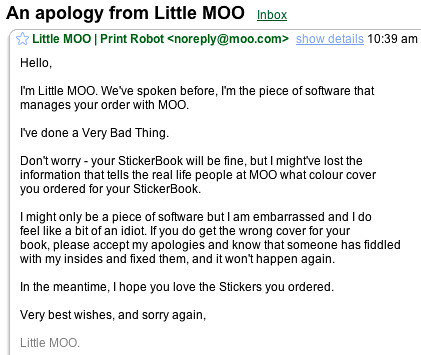
One service recovery actions done using technology that I thought was good is from Little Moo:


moo apology


Mistakes are part of innovation, and so it is important to recognise the role of mistake-making in creativity. The following video, with Richard Moross of Moo, refers to the above email and discusses how this mistake ended up as a point of innovation for this company.


Dealing with difficult customers and apologizing

Often customers get irate and angry. This video sets out 6 steps to deal with angry customers including the role of the apology in dealing with dissatisfied customers.   This video gives lots of really good advice about how to deal with dissatisfaction for staff that work in the front-line dealing with customers. Video covers the following tips: 

  1. Apologise
  2. Use diplomacy
  3. Go into computer mode 
  4. Be solution focused 
  5. Show empathy
  6. Thank the customer for giving you feedback


Critical worked example of service recovery by Jetstar


Let's look at a service recovery by using an example of a poorly managed service problem experienced by  Jetstar. The incident relates to a recent incident that was reported in the media about a young man who was so drunk he stood up and urinated in the aisle of a plane as it was traveling between NZ and Asia. In looking at this incident I am using a framework often used in communications analysis called 'The dramatistic pentad', which originated in the writing of Kenneth Burke. Basically, Burke argues that all human action is dramatic. He stated: "If action, then drama; if drama, then conflict; if conflict, then victimage”. In this framework, we use five aspects that help us describe and analyse the scenario. First, agents who are the people that perform the acts. Burke suggests that there are always rescuers, persecutors, and victims. Second, there is the act - that is what took place. Third, there is the scene or the background to the situation. Fourth there is agency, or the means and instruments the agent/s employ, and finally, there is the purpose or the motives that drive the act.

The particular incident is described in more detail in relation to these five aspects below:

1. Agent/s -  Inebriated passenger (Mr. X); Other passengers; Cabin crew

2. Act –  Inebriated passenger X stood up and urinated in the airline aisle. Passenger X was not following rules of appropriate conduct in an airplane. He was not violent or difficult. Just very drunk. The other passengers reacted with understandable disgust.  There are very strict rules of interpersonal engagement in economy class and sharing bodily fluids is not one of them. Because the incident occurred in economy class other passengers were immobile and unable to act. People remained/felt polluted/dirty for the remainder of the trip. The cabin crew did not react appropriately according to other passengers. Cabin crew facilitated some self-help clean-up (by giving passengers tissues). One cabin crew member reportedly giggled. Others apparently ignored the situation. There was a puddle and a scarf that was not cleaned.

3. Scene – The flight was a Jetstar flight to Auckland-Singapore. Place space is transient and liminal.
There is a temporary allowance of people to enter into each others' private space due to cramped conditions of economy flight. What little private space that was available was transgressed and made dirty.

4. Agency –  Interpersonal agency on the flight was used in that passengers and cabin crew entered into a series of communication events involving confrontation, appeals to disgust, outright complaints, humour, and denial. The media fastened onto the story after the plane had landed and passengers complained in public.  The media named and shamed the perpetrator. People had taken photos on the plane of the drunk passenger. The cabin crew was the focus of blame in the newspaper articles. Other victim disgust stories emerged of other similar incidents on other flights and there was a general venting about poor experiences on other Jetstar flights. Jetstar management then made a service recovery response. Staff were censured about the incident.  A public apology was made to customers and recovery package was awarded (upgrades etc.).

ž5. Purpose –  In terms of analysing this incident in terms of service recovery it seems clear that a number of processes could be put into place to minimise the chances of this type of thing happening again. What could they be? For management arguably their purpose was simply to dampen down an outbreak of vehemence against the airline. Although a service recovery process was undertaken, it was done late and there is some question about how meaningful the response was. 

Overall the point of a pentad approach is to analyse the relationships between elements so that an overall critical understanding of the incident can come through. For instance, it is not enough to simply describe the event using the five factors. The question is, overall who receives the greatest attention by the powerful rhetors (speakers) in this incident?  

My view is that the 'story' of this incident was not so much about a drunk young man on a flight but about relationships between passengers and cabin crew in economy class, and the relationship between cabin crew and management. Economy class passengers felt immobilised and powerless during their long transit. They mainly blamed cabin crew for lack of action to relieve their discomfort; they are the closest to them after all. Customers could not escape the situation and so sat for hours steaming over their problem. Once out of the plane passengers went straight to the media who then exacerbated their outrage by promoting a victim-perpetrator-rescuer story made all the more powerful because of its central message of pollution. The public response to censure staff and reward passengers did not actually get to grips with the basic problem on these flights - passenger and staff dis-empowerment. In the end the media story ended up being the 'tail that wagged the dog'. This is what the service recovery process focused on - the visible symptoms of hidden underlying issues. Service recovery should focus on the underlying causes and respond to those. 

Management's response* should be to examine their internal processes and think about how to stop this incident from happening again. This is their role - process management.  Yes, stopping further negative publicity is important, but more important is to look at internal procedures. First, tighten up on drunk passengers getting on the plane in the first place (manage the customer). Second, knowing that passengers are immobilised and staff frantically busy all the time on full economy flights, how can this type of incident be stopped? Train crew to respond more appropriately is another action. Training customers to respond is another. Empower staff to respond with appropriate things they can do to resolve a situation, like moving passengers into other seats. Perhaps enabling better communication between flight and ground crew so that recovery can be implemented as soon as the plane lands would be something else.   

Whatever the service recovery approach used, it is important that Management take responsibility for the incident and that the tendency to blame the customer or front-line staff is subdued. Recovery is appropriate and important but the focus should be on learning from the incident so that processes can be improved; this is management's responsibility.

* These issues could have been addressed in Jetstar's internal review processes so this post is not meant as a criticism of Jetstar or management.  


Tuesday, October 2, 2012

Customer Processing - KFC

by Fitirani Sari. Thanks to Fitriani for permission to publish her work on this blog.  


Executive summary 

The purpose of this report is to analyze management problems and business issues within the Kentucky Fried Chicken (KFC) Restaurant Chain and to recommend methods for improvement and achievement of the best possible business solution for the company (Babbar, 2002). 

KFC is one of the biggest fast-food chain restaurants in the world, primarily selling its unique, original recipe fried chicken. Due to competition in the fast-food industry, KFC needs to constantly update its service and meet customer expectations to maintain its place as a leader in the industry. On the other hand, KFC continually receives many complaints, mostly related to its service and food safety issues. These challenges could potentially alienate customers and affect the company’s image. 

This report discusses several critical issues in the fast-food process: service quality (Parasuraman, et al., 1988), food safety control,  increased competition in the market, and innovation in the fast-food industry. 

The report suggests that KFC can improve its service by adopting new technology to ensure its fast-food service is fast, differentiate its service from fast-food competitors, and engage with customers’ needs to improve and innovate in its service provision and so be a leader in the fast-food industry. 

Introduction 

News flash: KFC Vegan option added to menu!

This report's purpose is to carry out an analysis and provide advice as to how the business can be improved. 

As one of the biggest fast-food chains in the world, KFC dictates the standard for its products and services to its restaurants all over the world. This standard applies to all its franchises, but challenges still occur. KFC  faces many issues in terms of quality, service, resources, and management. KFC needs to resolve and continuously improve service if it wants to remain a top player in the fast-food chain industry. 

As an iconic service brand, KFC needs to be perceived as a service leader (rather than a qualifier or a loser).   Using service logic is therefore imperative for KFC as this will enable them to think innovatively. Service logic (Grönroos, 2000) begins with understanding what value is being delivered to customers and this means understanding  KFC's customers' end-to-end experiences. Simply, service value for customers occurs when they feel better after the service has been experienced than they did before they had the service (Grönroos, 2008). For KFC customers, several key moments (moments of truth) in the service experience are critical: these are waiting, ordering, and the quality of the food (which includes getting what was ordered). A complicating factor for KFC is that feelings (of satisfaction) are predetermined by the nature of their customers. KFC customers tend to make larger orders - family packs and/or party orders. Consequently, large orders are fairly common, as opposed to a fast-food outlet like McDonald's which handles more small individual orders. However, KFC customers may expect their meal to arrive as fast as it does at McDonald's, but the size of orders makes this challenging for KFC. 

A 'large event' requiring a large order is used to advertise KFC in a recent advertising campaign on TV and in the Youtube clip below. This shows that these larger orders are being targeted by KFC, and as one can imagine, fulfilling an order for this type of event so that all the food arrives hot in a timely way and without waiting is challenging.  

In order to co-create service value for customers, service providers need to adopt a service logic in building their facilities or services (Grönroos, 2008). This report will evaluate the issues KFC faces in service quality, food safety, and queuing systems, suggest recommendations for these situations, and suggest how to improve its service in order for it to remain a competitive and sustainable business.

Discussion 

KFC background 

Kentucky Fried Chicken (KFC) is a fast-food restaurant chain, which primarily sells well-known fried chicken with a 'secret spice' recipe. It was founded in Louisville, Kentucky, United States by Colonel Harland Sanders in 1952. Sanders started serving his fried chicken at his gas station in Kentucky in 1930. He then found a way to reduce the cooking time for his fried chicken by using a pressure fryer. Soon after he created the well-known 'original recipe' fried chicken that, as is well known from their advertising, is made with eleven different ingredients. 

When a new route was built that bypassed his town of Corbin, Sanders sold his properties and began to sell his chicken to restaurants, receiving a share of the profits from each piece of chicken sold. He gained a new partner to the fried chicken business in Utah in 1952. Together, the Colonel and his partner opened the first Kentucky Fried Chicken outlet (Nii, 2007). By the early 1960s, Kentucky Fried Chicken was sold in over 600 franchised outlets in the United States and Canada.

Sanders sold the entire KFC business operation in 1964 to Louisville business people for USD $2mill, equal to USD $14,987,124 in today’s money (KFC, 2011). The chain was sold in 1986 to PepsiCo, which made it part of its Tricon Global Restaurants division, which in turn was sold in 1997, and renamed Yum! Brands (KFC, 2011). (Check for later sales)

KFC was present in 110 countries and territories around the world by 2011. It had in excess of 5,200 outlets in the United States and more than 15,000 outlets in other parts of the world (KFC, 2011). KFC have operated in NZ since 1971 and have over 97 stores in the country.  

Due to the intense competition in the fast-food industry today, KFC needs to focus on continuous improvement of their service. Throughout its development, KFC has always focused on their product - chicken and other food items. It may appear that this focus on the product means they have not been so attentive to issues around service process and facilities. Customers complain regularly about all KFC service, and like with any service industry these complaints should be welcomed. However, they should also be listened to and acted upon. KFC needs to listen to complaints so they can see the frustration customers are feeling and what they should focus on to improve their service.  People like KFC chicken. But they complain about their service as can be seen in social media and websites. For instance, go here for a typical list from a complaint and compliment website, and search fro KFC.

For a service winner in a service industry complaints can have a big impact on the business. KFC does have service problems which might stop customers from buying their product. Thus, KFC has to find methods to meet their customer service expectations which are not currently being met (Heskett et al., 1994). 

Perhaps the most critical or major issue for KFC's is being able to deal with change. In a very competitive industry, a fast-food company needs to be constantly reflecting on their external realities. Overall KFC's focus must be on surviving and flourishing in the global fast-food industry. 

Service quality 

As stressed above, KFC's biggest issue is its service, not its product. Even though KFC has procedures for all eventualities, issues still occur because employees might not always follow these procedures. Parasuraman, Zeithaml and Berry (1985) linked customer satisfaction and behavioral intentions with service quality, saying that the success of organizations is highly related to perceived quality. Organizations providing superior service also experience high levels of customer satisfaction and positive rumor (Gilbert, Veloutsou, Goode & Moutinho, 2004; Gilbert & Veloutsou, 2006). Several studies address the issue of service quality and customer satisfaction in fast-food restaurants (Gilbert et al., 2004; Qin & Prybutok, 2008) reinforcing the applicability of general service quality measures to the fast-food industry. 

By using Parasutaman et al's (1985) SERVQUAL scale we can see the service quality of KFC from customers’ perspectives. The quality of service is determined by tangibles, reliability, responsiveness, assurance, and empathy (Gronroos, 2007). In service quality, tangible factors are related to the facilities, equipment and the appearance of the service provider. Reliability here means the accuracy of the service; that is, not making mistakes and delivering what has been promised in the setup time. Responsiveness means that the service provider is being helpful to the customers, and notifies customers when the service will be provided. Assurance is defined as an employee’s behavior, making customers feel secure, and that employees are always polite and have the information to assist customers’ requirements. Empathy means that employees understand customers’ problems and act based on customers’ interests, and give personal attention (Gronroos, 2007). 

Reviewing quality factors as identified above, and the lists of complaints available online about KFC, it appears that the service process could be improved. The commonest complaint about KFC ordering process is about accuracy. Employees often process incorrect orders and even sometimes misplace customer orders. Another common customer complaint is the waiting time for orders to be processed is too long. Customer expectations here are set by other fast-food restaurants like McDonald's and Burger King. Another common complaint is about long queues. Although KFC has drive-through options, during peak hours (lunchtime and dinner time), customers still experience long queues, both inside the store and at the drive-through. Although people enjoy the taste of KFC and it remains a popular chicken product, having a 'goods' focus to the detriment of the service process means that other important attributes of a fast-food restaurant not been dealt with satisfactorily. These factors include service response time, accuracy, and a range of other factors like cleanliness and the quality of prior service are also important factors (Qin, Prybutok & Zhao, 2010). 

Based on these issues, KFC’s problems might be understood as reliability and assurance. KFC is experiencing a service delivery gap, wherein quality specifications are not met by performance in the service production and delivery process (Gronroos, 2007). The cause of this gap can come from management and supervision, employee perspective of the procedure and a lack of technological/operational support (Gronroos, 2007). Another gap that KFC is experiencing is a perceived quality gap, in which the customers feel disappointed because the service that KFC gave is not the same as the expected service (Gronroos, 2007). The result of this could be negatively confirmed quality (bad quality) and quality problems, bad word-of-mouth and negative impacts of corporate, or local, image. All of these can lead to lost business. One thing that KFC should improve is their service recovery process so that this negative word-of-mouth can be changed to positive-word-of mouth (Spreng, Harrell, 1995).  

Service logic

Service logic from a customer perspective is when customers generate value for themselves when using resources offered by a service provider. On the other hand, from a service provider perspective, when they make interactive services, service providers create a chance to co-create value together with customers (Gronroos, 2008). KFC should employ service logic to add value creation to its customers. By employing service logic, the business should focus on building the service based on customers’ needs where they can have more freedom to choose their own product or service. Customers would like to customize their purchases and create their own service value and service providers could help the customers in the process. The form of service logic in the KFC could be self-kiosks service with nutritional details so then the customers could select their own menu and pay without influence from the employees and KFC could add value with adding nutritional information on the application. This would have the added value of helping customers to understand the healthier options KFC makes available. 

To improve the service 

When it comes to improving service fast food companies should employ new technologies, as the fast-food industry has gained a lot in terms of efficiency and customer support by applying simple ideas in technology. In fast-food restaurants reducing queue waiting time is essential. By making processes faster there is a direct improvement in customer satisfaction due to shorter waiting lines. Fast-food restaurants are now routinely using ordering channels, such as online and mobile ordering services. 

E-Commerce 

The adoption of the drive-through system by the fast-food industry was one of the main technological advances in the sector. Drive-through options helped reduce waiting times in the store and helped improve service efficiency. KFC has employed this system, yet there is still queuing in the drive-through line and inside the store. This means that KFC needs to employ other systems in order to reduce these queues; for example, takeaway and delivery services. Many fast-food restaurants apply e-commerce and m-commerce in their sales systems. KFC has delivery services in NZ now. By ordering online, however, customers can choose in their own time rather than waiting in a line to make an order, especially when in a group of people where it is harder to reach a consensus. Moreover, the advantage of online ordering is that people have access to the menu online, which makes it simple to choose from the several options normally available to customers. Whether or not these new ordering systems are reducing queues at the restaurants is unknown, but online complaints about waiting still abound. 

M-Commerce 

As Smartphones are becoming more widely used, people now do many things through their Smartphones. Smartphones have replaced the use of the computer for some people who not only browse on their phone but also buy using their Smartphone applications. Many businesses now build their shopping application platforms to attract the growing number of Smartphone users. For example, Domino’s Pizza has Domino’s mobile platforms. The company has announced £10m of sales in the UK in eight months period in 2011 via its iPhone application and almost fifteen percent of its total digital sales were made through Smartphones (Domino’s, 2012). KFC should adopt this m-commerce style as well in order to gain more customers and improve their service, giving its customers more purchase options. (Update this section)

Self-service kiosks 

The newest technology being used in the service industry are self-service kiosks, where customers control the entire process of purchasing, starting from choosing the menu to carrying out their own payment without any assistance from a staff member. Self-service kiosks are now not just used for ordering and payment, but can also display nutritional and other promotional campaigns. These kiosks are more common in Quick Service situations and are used mostly as a remedy for queues. McDonald's has already replaced cashiers with self-service kiosks. Branches in Texas USA trailed nutritional kiosks that have a 'build a meal' application to help customers review the menus and nutritional details in their selected menus (Kelso, 2010) to improve the customer service experience. KFC should employ similar technology and compete with other fast-food restaurants to win customers. Moreover, by adopting self-service counters, companies can reduce the cost of labour and eliminate human error. Many factors can affect a human cashier, with errors tending to increase during busy times (Hoeft-Wessel, 2010). 

Differentiate the service 

Other than adopting the new technologies mentioned above, KFC could provide better service to influence the waiting experience such as by providing TV and magazines so that customers could watch or read when waiting. Or KFC could provide a playground for children so they can play while their parents are waiting in line and/or eating. KFC is already very successful at differentiating its products from its competition with KFC's famous original fried chicken. To attract its customers, KFC should differentiate its service as well. This could be the way to market their brand and also give back to customers by providing better service. 

Long-term 

KFC employs a mix of low cost and differentiation leadership strategy (Peng, 2009), as it can count on its brand name and original taste and recipes to be unique, while at the same time it competes on price using the benefits of cost savings from economies of scale. One of their main goals is to take advantage of potential growth in new territories, to establish a strong position and to develop their image. Crucial factors are to continue cost savings through R&D, innovation and to adopt new technology to enhance efficiency. These methods will reduce costs and increase margins in the industry. 

KFC also needs to focus on health issues, as it has a fast-food image and is generally considered to produce unhealthy food. The current generation is, on the whole, more health-conscious than previous generations. Many people consider a healthy menu to be very important and more of a determinant to choice than price. Companies already implemented in the market are adapting their menus to make them healthier. Thus, KFC needs to find something healthier to put on the menu. 

KFC has, in the past, always concentrated on its product. To maintain its leadership in the industry KFC needs to focus on what customers want and follow market changes, as well as continue to improve their service as well as their products. In the age of social media, KFC also needs to follow the trends to engage with social media users. This is not just important for marketing, but for listening to and learning what customers want and need. With this, they can be a step ahead of their competitors in the industry. 


Conclusions

Competition has become increasingly intense in the fast-food industry. Fast food restaurants are expected to be fast and accurate in delivering orders. Complaints are common and include mistakes like packing orders incorrectly and also the ubiquitous problem of customers waiting in line. KFC has focused on their tasty product but they need to focus more on service. Complaints should be listened to and made the focus of operational improvements. Many complaints from customers indicate KFC often delivers poor service despite having detailed service process procedures.

KFC should apply a service logic to their operations.  KFC has 'drive-through' but the service world is changing very fast. Competition is very high in the fast-food industry. Competitors are building their service to keep up with customers’ needs. KFC needs to do at least the same, and preferably better than their fast-food competition.   


Recommendations

To improve the service 

KFC should use service technology to improve its service such as employing e-commerce practices in their service - for example, online ordering. Another way to improve the service is through employing m-commerce, which is now a trend for service-based business due to the growth of mobile phone technology. 

To increase service accuracy and solve the queuing problem KFC could adopt new queuing systems that separate the ordering queue and the waiting queue and provide self-service kiosks, which would minimize human error. These self-service kiosks could have an additional function which provides nutritional screens that show the calories in meals being ordered. This will allow the customers to choose and review the meal that they will buy. 

To understand its customers KFC should try to be more interactive in engaging with customers through social media, such as Facebook and Twitter. 

Long-term: 

KFC should place greater focus on product innovation. It should learn about customers preferences and create new menus. Therefore, the role of R&D is essential to remain a leader in the field. The R&D department needs to differentiate KFC products from other similar products and create a competitive advantage. For example, it should consider aiming for healthier products as people now tend to be more conscious about their health. 

KFC should use service logic, which focuses on customer needs in order to create a better service experience and improved quality

References (to be updated)

Babbar, S. (1992). A dynamic model for continuous improvement in the management of service quality. International Journal of Operations and Production Management, 12(2), 38pp.

Domino’s mobile platforms taking a slice of mCommerce. (2012). Retrieved from http://www.appstechnews.com/blog-hub/2012/apr/25/dominos-mobile-platforms-taking-a-slice-of-mcommerce/ 

Gilbert, G.R. and Veloutsou. C. (2006). A cross-industry comparison of customer satisfaction. Journal of Services Marketing, 20(5), 298-308. 

Gilbert, G.R., Veloutsou, C., Goode, M.M.H. and Moutinho. L. (2004). Measuring customer satisfaction in the fast food industry: A cross-national approach. Journal of Services Marketing, 18(5), 371-83. 

Grönroos, C. (2007). Service management and marketing: Customer management in service competition (3rd ed.). Chichester, West Sussex, England Hoboken, NJ: John Wiley & Sons. 

Grönroos, C. (2000). Creating a relationship dialogue: Communication, interaction and value. Marketing Review, 1(1), 5pp.

Grönroos, C. (2008). Service logic revisited: Who creates value? And who co-creates? European Business Review, 20 (4), 298-314. 

GSN. (2008). I've got a secret interview. [Radio Broadcast] originally broadcast April 6, 1964 (rebroadcast by GSN March 30, 2008).

Heskett, J. L., Jones, T. O., Loveman, G. W., Sasser, W., & Schlesinger, E. (1994). Putting the service-profit chain to work. Harvard Business Review, 72(2), 164-170.

Hoeft-Wessel. (2010). Self-Service Shopping: Advantages for Both Retailers and Customers. Retrieved from http://www.hoeft-wessel.com/en/press/0409_Retail_Digest.pdf 

Kelso, Alicia. (2012). Kiosks helping McDonalds' customers order healthier meals. Retrieved from http://www.selfserviceworld.com/article/191550/Kiosk-helping-McDonald-s-customers-order-healthier-meals 

KFC. (2011). About Us. Retrieved from http://www.kfc.com/about/ 

Nii, Jenifer K. (2004). Colonel's landmark KFC is mashed. Retrieved from Desert Morning News http://www.deseretnews.com/article/595057690/Colonels-landmark-KFC-is-mashed.html. 

Parasuraman, A., Zeithaml, V.A. and Berry, L.L. (1985). A conceptual model of service quality and its implications for future research. Journal of Marketing, 49 (4), 41-50.

Parasuraman, A., Zeithaml, V., & Berry, L. (1988). SERVQUAL: A multiple-item scale for measuring customer perceptions of service quality. Journal of Retailing, 64(1), 12—40.

Peng, M. W. (2009). Global strategy (2nd ed.). Mason, Ohio: South-Western.

Qin, H. and Prybutok, V.R. (2008). Determinants of customer-perceived service quality in fast food restaurants (FFRs) and their relationship to customer satisfaction and behavioral intentions. Quality Management Journal, 15 (2), 35-50.

Spreng, R., Harrell, G.and Mackoy, R. (1995) Service recovery: Impact on satisfaction and intentions, Journal of Services Marketing, 9 (1), 15 - 23

Sunday, March 4, 2012

Les Mills International - Service Case Study Part 1

Introduction

The purpose of this article is to provide an introduction to basic service management terminology through using the example of Les Mills International, a New Zealand-based international group-fitness company. This article features links to Wikipedia and other knowledge and information bases as further reference to  key service management terms, and also provides key readings.This article also links to publicly available videos of Les Mills activities and other web sites of interest. The source of these videos is mainly Les Mills International Youtube Channel. I also draw on interviews I conducted in 2005 with group fitness workers, notes on a presentation given by Phillip Mills at the Go Global Conference in 2005 (now no longer available on the web) and a paper prepared for a conference.

This article focuses on explaining general terminology to serve as an introduction to service management 'jargon'.


Introduction to Les Mills International 

You can see a brief video introducing Les Mills history and programmes here on the Les Mills main site.

Facts about Les Mills:
  • Les Mills is a famous NZ Olympian and founded  Les Mills World of Fitness chain of gyms in Auckland, New Zealand and also Les Mills International. 
  • At present Les Mills (LM) operates in about 14,000 gyms and health clubs in 75 countries. 
  • There are an estimated 70, 000 Les Mills Instructors worldwide.
  • About 5 million participants participate in a LM class every week.
Les Mill's son Phillip Mills was largely responsible for developing a series of exercise-to-music programmes, including BODYATTACK®, BODYFLOW® , BODYCOMBAT®, BODYJAM®, BODYPUMP®, BODYSTEP®, BODYVIVE®, CXWORX® and SH'BAM® (all fiercely protected registered trademarks).

Les Mills International Wikipedia page says "In 2004, Phillip Mills was Ernst & Young's New Zealand Entrepreneur of the Year, and the following year he competed in Monaco as a finalist for Ernst & Young's World Entrepreneur of the Year award. In 2005, Les Mills International was named New Zealand Services Exporter of the Year by NZ Trade and Enterprise and, in 2007, he and wife Jackie Mills co-authored the book 'Fighting Globesity - A Practical Guide to Personal Health and Global Sustainability'" (see Part 2 for more on this). If you are unfamilar with Les MIlls then have a look at a few of the videos featured in this article, or go here to see their webpage and an introductory video.

Outside-In Perspective

Within service management it is now common to argue that all service industries, in fact, all businesses, should take an outside-in perspective. That is, service managers should learn to look at all aspects of their processes from a customer's viewpoint (see Note 1 below).

One useful way to do this is to conduct a walk-through or an emotional audit from a customer's perspective. The following provides an example of a narrative of a customer attending a group fitness session. It illustrates both the feelings and processes that a customer engages with as she participates in a group fitness routine.  The video below shows the 'release' of a new BODYSTEP® routine (release number 84) to help you visualize the narrative.


Outside-In Perspective 

Getting to the session is the first challenge. I am tired and grumpy and don’t really feel like going, but experience has taught me that if I at least get to the session then the music will carry me through the session. ‘Classes’ are timetabled. 9.00 am in the morning is a good time for me. I have dropped the kids off at school and make my way just in time to fill up my water bottle, pay my fee, and dig my towel out of the bottom of my bag. I collect my Step, place my card in the instructor’s receptacle and take up my place behind the Step.

The music begins with the first of 12 tracks that make up the session. The first track is ‘Venus’, by Bananarama. People quickly move to their chosen area. They have placed before the stage already what they need to conduct their ritual: water bottle, towel, and Step. The arrangement of the room is all face-forward towards the stage. The session is to last fifty-five minutes as other activities are scheduled before and after.

The instructors remind us of safety – this is usually on their minds at the beginning of the session. Today there are two instructors, slim and toned, with coordinated clothing, tanned and with wide smiles.

The lyrics to the ‘Venus’ track say: 'Goddess on the mountain top, burning like a silver flame, the summit of beauty and love, and Venus was her name. She’s got it. Yeah, baby she’s got it. I’m your Venus. I’m your fire. At your desire’. We start to warm up, moving around the Step, walking at a clipping pace. The music provides the impetus. We move straight into the second track, ‘Get Down On it’, by Peter Andre. The song is a direct challenge to dance. The pace picks up and we start walking up onto the Step, with some squats included. The ‘butt and thighs’ start to be worked now that the muscle groups are warmed up. This is a vigorous track and most people quickly take on some water at this point. At this point the energy of the dance and movement starts to be felt. The movements start to come easy. Once the rhythm is entered into then the 1-2-3-4 time is relatively easy to keep with, and when the movements are learnt they can be reproduced without much thought. The basic movements are all learnt: the simple step, over-the-top, grape-vine, turn-step, walk-over, and the stomp are a few of them. The steps can be related to particular genres of music too: a recent favorite has been the cha-cha, which involves a skip step.

Track 3 is ‘Born to be alive’ by Voyager, and an affirmation of life. The lyrics are less important now,  but the beat is relentless and loud. I am starting to perspire. I concentrate on keeping up and getting the moves right. I am now completely focused on myself and watching the instructor. I cannot see others around me. I get out of rhythm at one point, feel embarrassed, but quickly find it again. We are reminded to keep the noise of our feet down. This is a safety reminder. 

Track 4 is ‘Absolutely Not’ by Deborah Cox. It is a stroppy track reflecting issues of self-esteem at work. ‘Should I wear my hair in a ponytail? Should I dress myself up in Chanel? Do I measure me by what you think? Absolutely not, absolutely not’. I enjoy this track. The movements are fluid and simple and involve a move at the peak of the track where the participants mime pulling a person towards them and then kneeing them . The male instructors joke in  good nature when the women enthusiastically participate in this track.  

Track 5, ‘The Wreckoning’ [sic] by Boomkat is a mixed strength track where the aim is to work on the ‘butt and thighs’ after a high aerobic work rate track. The pace is slower for squats and lunges — strenuous exercises that work the big muscle groups of the legs. The song is ostensibly about a relationship break-up; a play on the word reckoning with ‘wreckoning’ (the wreck of the relationship). The other reckoning is to face the toughness and pain of the physical lunge and squat and have a reckoning with your body about its ‘true’ state of being. The time is nigh in other words to face the truth. I always feel good about this track. By this time in the session I am feeling extremely virtuous. I feel great. 

Track 6 ‘I’m flying’ is one that I hate. I face my un-coordination in this track and always do it at the lowest options. I have fallen off my Step twice doing this track as I try and follow the instructor’s movements. We mimic a bird flying in the sky while we do an ‘Over-the-top’ move across the length of the Step box. The technique means we raise our arms, increasing blood flow around the body. This raises the heart rate, making the body work harder. I suffer it in silence and can’t wait for it to be over. I keep my arms down and focus on not falling over. The instructors seem to like it.

‘Situation’ (7) by Tom Jones and then ‘Disco Inferno’ (8) by Tina Turner are classic high peak tracks. Tom Jones’ voice has visceral power — deep and powerful — perfect for lunges. So, I think, I am a house-wife pretending to be Tom Jones. In the next track I am being a black woman — Tina Turner — even better. I always wanted to be born black — black people seem cooler, looser. They’re not so uptight. What would it feel like to be born a man, or black, or both? ‘Situation’ provides a strong pulsing rhythm to which we do squats which drives the heart rate up. This is another ironically named recovery track. ‘Disco Inferno’ is a faster song with the mood encouraged being ‘out-of-control’, with an flurry of physical movement to Disco moves. You have to be fit to have fun with this track. Other people work really hard, and I aspire to do the same. But, to be honest I never feel completely conscripted into the process or fit enough to lose myself in the moves. I am getting tired and slightly depressed with my inadequacies. I try to turn off my thoughts and push my body back into the music. 

Patti La Belle’s gospel standard ‘Ready for a Miracle’ (9) and then Eye of the Tiger (10) are the final peak tracks. By this time we are getting near the end of the session and I really do need a miracle to get through. The instructor yells at us now, ‘Get up! Get down! Rise up! Look at me!’ She is never silent, and as she demonstrates the moves, always having to think slightly ahead of her audience (and doing everything, like Ginger Rodgers to Fred Astair, backwards), gives previews of changes in moves, demonstrating the ideal movements. The noise from feet pounding on the floor and on the step, in time, is loud, rhythmic and hypnotic. From time to time the instructor calls out to the class asking them to tell her they are OK. ‘Have you got there yet?’ ‘Is it a miracle?!!’ The pace is absolutely frenetic. At the peak of the track we all wave our hands in the air mimicking the ecstatic body movements of revelation at the height of a Pentecostal revivalist meeting. At several points during this track a few class participants yell back to the instructor, whooping to show their enjoyment of the track. The Eye of the Tiger is a novelty track and a bit of fun. The mood starts to loosen, but the beat of the track is aimed at pushing us to a final sprint towards the finish line, eking out the last spurt of energy, leaving me completely spent. 

My favorite part of the session is next – the press-up and sit-up track. I have come to love press-ups — I really don’t know why as my arms are as weak as a kittens’. I push myself really hard. I try and ignore the instructor — she is background noise. I don’t have to look at her any more and I settle into my own rhythm to the music. The song is ‘My Time’ by Dutch. The lyrics say, ‘Been a long time since I saw my own mind … I was moving in the shadows, always looking at the past … Always, always, put my faith in new days ... I dancing and I’m feeling fine … This is my time, this is my time’.

The final stretch track is ‘Cruisin’ sung by Gwyneth Paltrow and Huey Lewis. The song is melodic. It is about surrender and release. ‘Let the music take your mind’ it says, ‘Just release and you will find … , You're gonna fly (away), Yeah, I'm glad you're going my way'.... The stretches are genuinely relaxing. The instructors pose like statues on the stage, moving from one fluid position to the next. I am sometimes reluctant to leave one stretch for the next. As the last stretch is completed and the music fades, we pat ourselves on our backs. This move of self-congratulation is part of the choreography. Everyone puts their things away and some move off to the shower. I stop and talk quickly with another regular attendee. I feel pretty good and am glad I made the effort to come. Then we all hurry off to get on with our day, appointments and work. 


Understanding Service as Intangible involving a Transition, and the Service Concept

A service delivers an intangible product. A service is something that has no physical or material presence (although it can be attached to material products in a service bundle). According to Phillip Mills "Everything we do is just about invisible”. LM tangibilises experience (makes the intangible tangible) through video, training DVDs with choreography, notes, and other educational material, fashion and a vigorous branding platform. 

Les Mills International delivers group exercise experiences. During the course of a customer's experience journey with Les Mills they will go through transitions in their whole selves - emotionally (their feelings), physically (their bodies), aesthetically (how they look), and spiritually (their sense of completeness and one-ness with the world). This is not an exaggeration - see the narrative above as all these aspects of these transformations are experienced during the participant's journey and are symbolically communicated through the group fitness system (which will be explained in more detail shortly).

This transition is illustrated below:


The service concept in general is explained below:


Phillip Mills himself explains the core of what the service concept is in a Les Mills group fitness class: results and motivation, and the ways that they have built a focused understanding of the value proposition of their business. The video is aimed at potential licensees of Les Mills. As explained above, Les Mills International are using a type of franchise model to expand, which is common with service businesses. Phillip Mills is 'selling' the brand to other business, a type of Business to Business (or 2B2) communication, because other businesses are Les Mills International major customers. Despite being an 'infomercial' the following video provides some insights into how Les Mills International works, and what their priorities are. 


This article is continues in Les Mills International Part 2

Notes

Note 1: Of course the logic of the outside-in  perspective leads to a strengthening of the already powerful notion that the 'Customer is King' (or Queen). This is one reason for the need to for us to understand our obligations as consumers (I prefer to remember that consumer is a subset of the word citizen). One of my favorite sayings is "Your wish is my command" from the musical 'Annie'. This saying is a reminder of the reciprocal obligations between service organisations and citizen-consumers to provide services and products responsibly; that consumers have a mutual responsibility in other words and their desire (for things and services) does not preclude ethical behaviour.

References


Johnston, R., & Clark, G. (2008). Service operations management: Imporving service delivery. Harlow: Prentice Hall.


Notes on group fitness regimes and music as organisational technology

Photo license:   Flickr image by cooyutsing at http://www.flickr.com/photos/25802865@N08/6853984341/      Introduction The purpose of this a...